Bone Loss After Menopause: Why It Speeds Up and What Helps
A plain guide to why bones thin faster after menopause, who should get a DXA scan and when, and the everyday steps that help.
Read the article

Injury and Recovery · 5 min read
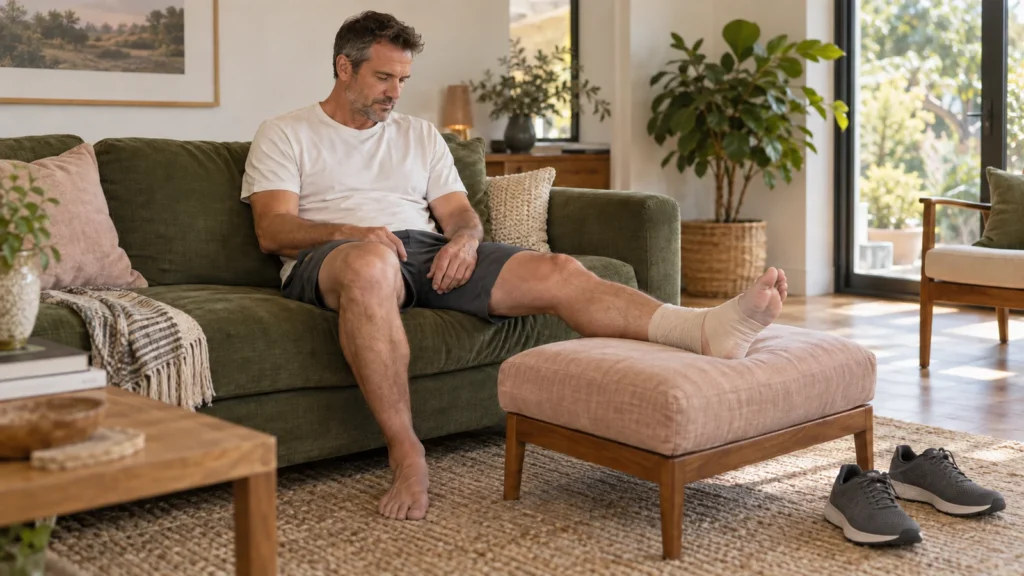
Injuries heal slower after 40 because the body replaces muscle more slowly and tendons lose flexibility with age. Deep sleep and several hormones drop over the same years. Knowing which change slows your injury tells you what to work on first.
Muscle changes often begin in the 40s in women and in the 20s in men, according to MedlinePlus, from the National Library of Medicine.
The same page says muscle fibers shrink with age, and the body replaces muscle tissue more slowly. It adds that tough fibrous tissue may take the place of lost muscle, and that loss of muscle mass reduces strength.
A 2015 review from Salzburg, Austria, describes tendons as poorly supplied with blood. It says they heal poorly compared with bone or skin.
Researchers in Copenhagen dated Achilles tendon tissue in a 2013 study, using carbon released by nuclear bomb tests between 1955 and 1963. They found that the tendon core forms during the growing years and is essentially not renewed after that.
By contrast, muscle samples in the same study showed continuous renewal. The authors say the tendon’s lack of renewal likely explains why tendon tissue is poor at rebuilding itself.
Age changes tendons as well, according to a 2016 review from the University of Copenhagen. Lab studies it cites find fewer stem-like cells in aging tendon tissue. Sugar-based cross-links build up in tendon collagen with age, the review adds, and aging appears to lower tendon strength.
Tendons become less flexible as you age, which makes tendonitis more likely, says a National Institutes of Health guide on sports injuries. It also says knee tendon tears “tend to be more common in middle-aged people who play sports that involve running and jumping”.
If a tendon has hurt for months, our post on tendinosis vs tendonitis explains why it needs a different plan.
Deep sleep drops by midlife, and a night without sleep slows muscle building the next day. A 2000 study of 149 healthy men, published in the Journal of the American Medical Association, compared sleep across ages.
For men aged 16 to 25, deep sleep took up 18.9 percent of the night. By ages 36 to 50, it was 3.4 percent.
Growth hormone release showed a large drop over the same years. The study also found that, at any age, more deep sleep went along with more growth hormone.
In a 2021 study from Deakin University in Australia, one night without sleep cut muscle protein building by 18 percent in healthy young adults. Sleep loss also raised cortisol by 21 percent and lowered testosterone by 24 percent.
Several hormones fall with age. MedlinePlus lists growth hormone among the hormones that usually decrease, and says women have much lower estrogen after menopause. Testosterone usually falls gradually as men age, the same page says.
A 2004 review from the University of Southern California counts hormone changes, diet changes and inactivity among the causes of muscle loss with age.
Hormone therapy is not an approved treatment for an injury.
Short rest is part of first aid, and MedlinePlus advises resting a sprained joint for several days. Beyond that, complete rest costs strength quickly.
A 2008 study from the University of Arkansas for Medical Sciences put 11 healthy adults, average age 67, on 10 days of bed rest. Every measure of leg strength fell, and the strength to straighten the knee dropped 13.2 percent. Stair climbing power dropped 14 percent, and aerobic fitness was 12 percent lower.
Rehab with exercise usually comes before a return to the activity that caused the injury, according to a National Institutes of Health guide.
MedlinePlus lists warning signs for sprains and strains. Go to the hospital or call 911 right away if any of these apply.
Call your doctor if any of these apply.
Adrienne Towsen, MD, is a board certified orthopedic surgeon. The American Board of Orthopaedic Surgery certified her in 2006, and she finished a sports medicine fellowship at Thomas Jefferson University Hospital.
She no longer performs surgery, and we do not do injections or physical therapy here. When the clinic opened, she wrote to her patients: “My focus now is more about prevention and health optimization”.
Our recovery work looks at training load, sleep, lab work and body composition, with injury prevention built on her orthopedic background. A hormone review is part of the lab work, and it does not treat the injury itself.
The clinic is on the third floor of the North Hills Medical Building at 795 East Marshall Street, Suite 303, in West Chester. Chester County Hospital is next door.
Patients come to us from West Chester, Exton, Malvern, Glen Mills, Wayne, King of Prussia and Newtown Square.
If injuries take longer to settle than they used to, one appointment is worth booking. It looks at your sleep, training load, labs and body composition together.
Our page on injury prevention and performance medicine in West Chester describes what the program includes.
A first visit is 60 to 90 minutes and costs $295. See how the first visit works for the steps. Lab results usually come back in 3 to 5 business days.
Call (484) 803-5448 to book.
A plain guide to why bones thin faster after menopause, who should get a DXA scan and when, and the everyday steps that help.
Read the article
Aching joints are one of the most common complaints around menopause. This guide covers the estrogen link, other causes to rule out, what helps,
Read the article
A plain guide to why knees hurt after 40, what the guidelines say helps, and the signs that mean a doctor should see your
Read the articleBook a visit at our West Chester office and bring your questions.
Book a consultation