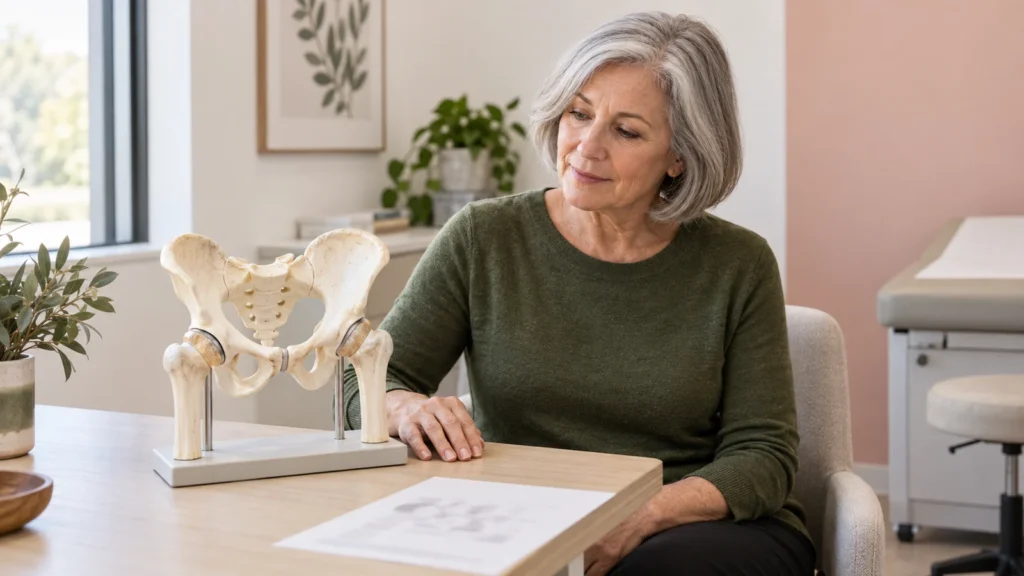
Bone Loss After Menopause: Why It Speeds Up and What Helps
A plain guide to why bones thin faster after menopause, who should get a DXA scan and when, and the everyday steps that help.
Read the article
Injury and Recovery · 6 min read
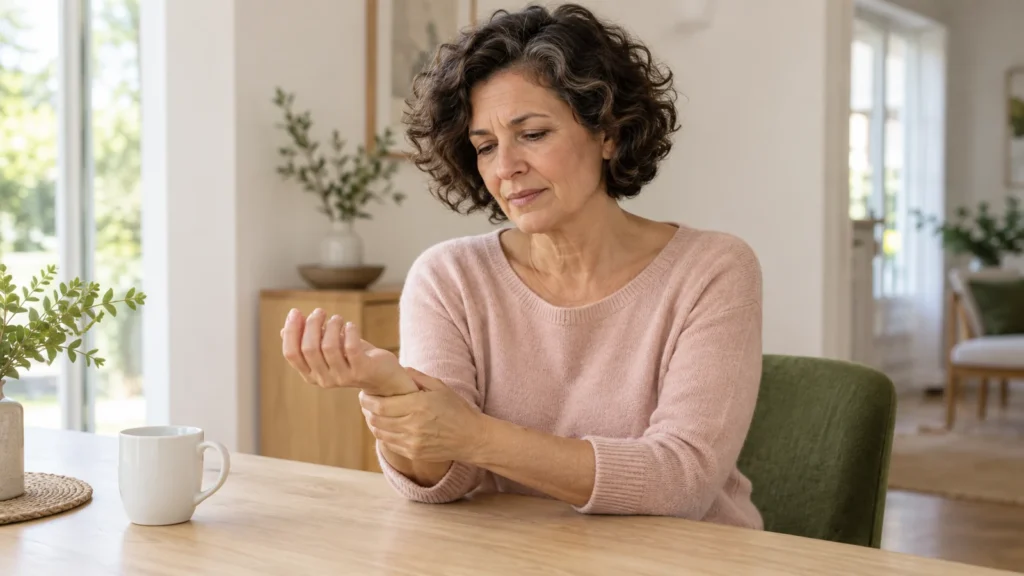
Menopause can make your joints ache. Joint and muscle pain are some of the most common symptoms of menopause, according to a 2023 review in The Lancet Rheumatology.
Other problems can cause the same aches, including arthritis, gout and an underactive thyroid. A 2026 article in the journal Menopause says a doctor should rule those out before naming menopause as the cause.
Estrogen acts on the tissues in and around your joints. The 2026 article in Menopause notes estrogen receptors in bone, cartilage, joint linings, muscles and tendons. It says low estrogen affects all of those tissues.
Researchers in Australia followed 438 women aged 45 to 55 for 8 years, in a study published in the journal Climacteric in 2008. Aches and stiff joints were the symptom they reported most, and women going through the menopause transition were more likely to report them.
A 2026 review in JBJS Open Access, an orthopedic journal, pooled 37 studies covering 93,021 women. Before menopause, 40 percent of women in those studies had muscle or joint pain.
That figure rose to 57 percent during perimenopause, the years leading up to the final period, and to 59 percent after menopause.
Women describe pain and stiffness in several joints without obvious swelling, according to the 2026 article in Menopause. The pain often shows up alongside other menopause symptoms, such as hot flashes, mood changes and poor sleep.
No blood test or scan can confirm menopause joint pain, the article adds. In general it does not damage the joint, though it can be disabling.
Aches and stiff joints after menopause did not always mean osteoarthritis on an X-ray, the 2008 Climacteric study found.
According to the 2026 article in Menopause, care should start by finding and treating other causes, including these.
The 2026 article in Menopause advises strength training for women with joint pain. It says low impact, high intensity exercise can protect joints while building muscle.
In the 2008 Climacteric study, women with a higher body mass index, a measure of weight for height, reported more aches and stiff joints.
A 2019 guideline from the American College of Rheumatology strongly recommends exercise for knee and hip osteoarthritis. For people with that arthritis who are overweight, it strongly recommends weight loss too.
Hormone therapy is not FDA approved to treat joint pain. FDA labels for estrogen products list other uses, such as hot flashes, vaginal dryness and preventing osteoporosis after menopause.
A 2013 report in the journal Menopause looked back at joint pain in the Women’s Health Initiative trial. The report covered 10,739 women who had a hysterectomy in the past. Each took a daily estrogen pill or a dummy pill.
After one year, 76.3 percent of the estrogen group reported joint pain, against 79.2 percent of the dummy pill group. Its authors called the difference modest, and it lasted through year 3. Joint swelling was more common with estrogen: 42.1 percent against 39.7 percent.
The trial tested one product, conjugated estrogens. No large trial has tested hormone therapy specifically as a treatment for joint pain, the 2026 article in Menopause notes.
A 2026 review of 57 studies, in the journal Post Reproductive Health, compared women who had used hormone therapy with women who never had. It found no clear difference in general muscle and joint pain.
MedlinePlus, the health site of the National Library of Medicine, says to contact a doctor if any of these apply.
Swelling, warmth and “striking morning stiffness” point toward inflammatory arthritis, such as rheumatoid arthritis, the 2026 article in Menopause adds. A new rash or marked muscle weakness alongside joint pain can point to lupus or another autoimmune disease.
Adrienne Towsen, MD, is a board certified orthopedic surgeon. The American Board of Orthopaedic Surgery certified her in 2006. Her training includes an orthopedic surgery residency at Allegheny General Hospital and a sports medicine fellowship at Thomas Jefferson University Hospital.
She no longer performs surgery, and we do not do injections or physical therapy here.
For joint pain around menopause, we look at your symptoms, your hormones and your lab work together. Testing covers hormone panels, thyroid, metabolic markers, inflammatory markers and body composition.
Dr. Towsen’s own published focus is “maximizing musculoskeletal potential and injury prevention”. Our page on injury prevention and performance medicine in West Chester covers the joint health side of the clinic.
Towsen Clinic is at 795 East Marshall Street, Suite 303, West Chester, PA. The office is on the third floor of the North Hills Medical Building, next door to Chester County Hospital. Patients come from West Chester, Exton, Malvern, Glen Mills, Wayne, King of Prussia and Newtown Square.
If your joints started aching around the time hot flashes or poor sleep began, one visit can look at all of it together. Our page on bioidentical hormone therapy in West Chester, PA explains how hormone care for menopause symptoms works here, from labs to follow-up visits.
A first visit is 60 to 90 minutes and costs $295. Lab results usually take 3 to 5 business days, and our page on how the first visit works lists each step.
Call (484) 803-5448 to book.
A plain guide to why bones thin faster after menopause, who should get a DXA scan and when, and the everyday steps that help.
Read the article
Muscle, tendons, sleep and hormones all change after 40. This guide explains the research on each change, what helps recovery, and which signs need
Read the article
A plain guide to why knees hurt after 40, what the guidelines say helps, and the signs that mean a doctor should see your
Read the articleBook a visit at our West Chester office and bring your questions.
Book a consultation