

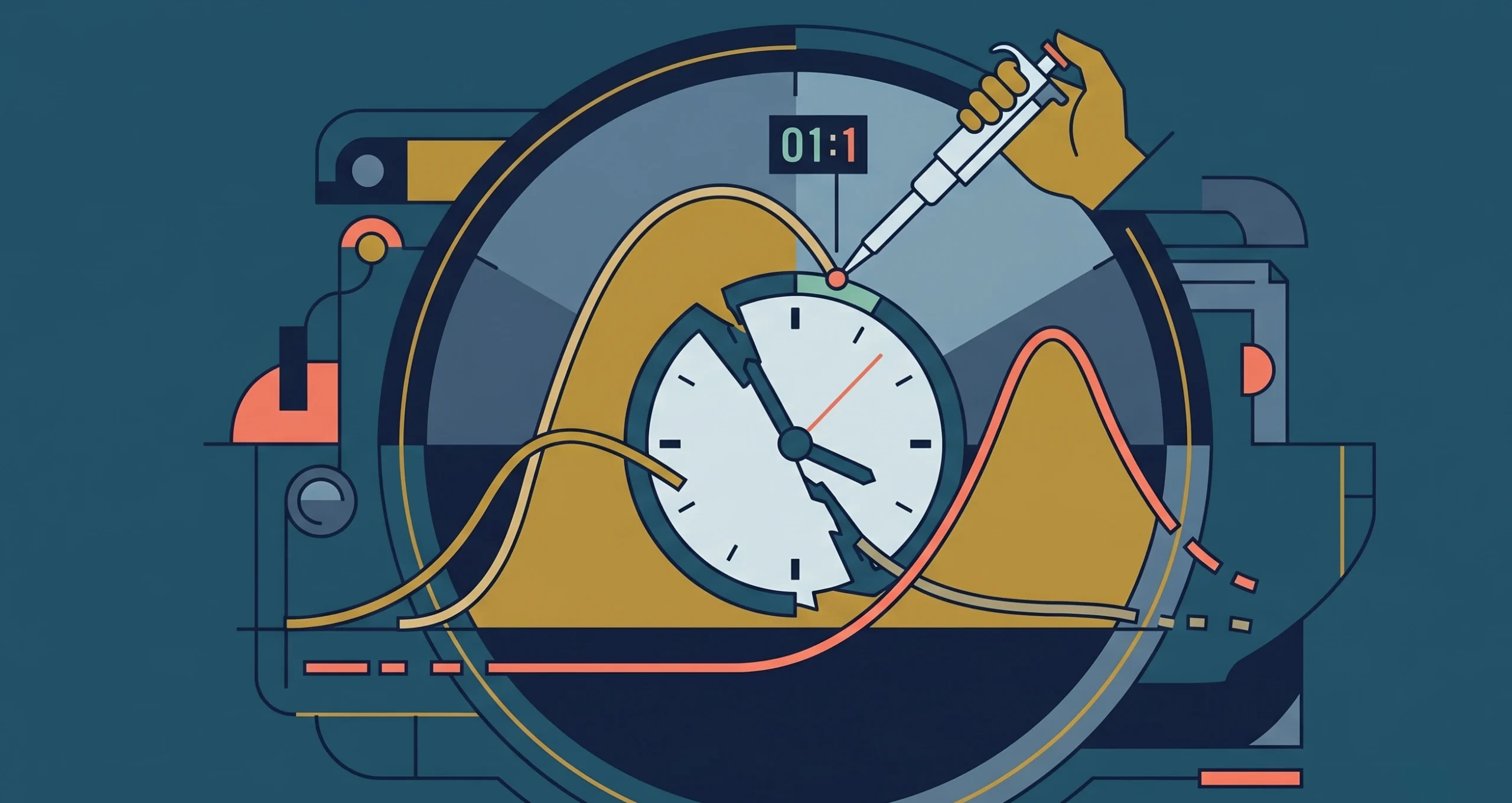
If you are a partner at a law firm, a healthcare administrator, a founder, or a senior executive in pharma, your relationship with cortisol has been mismanaged for years. Not by you. By the way the medical system tests for it.
The standard cortisol test in primary care is a single blood draw, usually at 9 AM. The result either falls in the reference range or it does not. If it does, you get told your cortisol is fine and the conversation moves on. If it does not, you get sent to endocrinology to rule out Cushing’s syndrome or Addison’s disease, both of which are rare.
That binary outcome misses the actual problem in nearly everyone who is not severely diseased. Cortisol is not a single number. It is a pattern across 24 hours. The pattern is what matters, and a one-time blood draw cannot see it.
The Adrenal Fatigue Argument and Why It Was Half Right
Mainstream endocrinology rejected the term “adrenal fatigue” for good reasons. The adrenal glands do not actually fatigue. In Addison’s disease, where the adrenals genuinely fail, the clinical picture is dramatic and life-threatening. Most patients labeled with adrenal fatigue have nothing close to that.
But the criticism missed the real story. The HPA axis (hypothalamus to pituitary to adrenal) does dysregulate. Its rhythm flattens. Its peaks shift. Its troughs deepen. The adrenals themselves are working fine. The signaling around them is not.
This distinction matters because it changes what you test for and what you treat. “Adrenal fatigue” was the wrong word. HPA axis dysregulation is the right concept, and it is well-documented in the cortisol awakening response literature. It is also extremely common in high-performing professionals.
The Healthy Cortisol Curve
In a healthy person, cortisol follows a predictable 24-hour shape. It rises sharply in the last hour of sleep and peaks 30 to 45 minutes after waking. This morning peak (the cortisol awakening response, or CAR) is what gives you that sense of natural alertness without coffee. From there, cortisol declines steadily through the day, reaching its lowest point around bedtime, when melatonin takes over and you fall asleep.
When this curve is intact, you wake up alert, you focus through the day, you wind down naturally in the evening, and you sleep through the night. When it is disrupted, every part of that breaks.
The Three Common Patterns in High Performers
Years of working with executive patients reveal three cortisol patterns that show up over and over.
The blunted morning response. The patient cannot wake up. The morning peak that should be lifting them out of sleep barely registers. They need stimulants (caffeine, sometimes more) to feel functional in the first two hours. By mid-morning they feel okay, but the energy is borrowed. This pattern often shows up in people who have been pushing hard for years and whose CAR has flattened.
Elevated evening cortisol. The patient gets a “second wind” between 9 PM and midnight that they think is productivity but is actually a stress signal. They cannot fall asleep until 1 AM. Even when they do, sleep is light and shallow. Mornings are rough because the body never got the deep cortisol-low window it needed to make the rebound. This is the classic “I work best at night” pattern that often turns out to be physiology, not preference.
The flat-line all day. Cortisol stays in a narrow band the whole 24 hours. There is no morning peak, no evening trough. The patient feels low-energy all day and tired-but-wired at bedtime. This pattern is most common in late-stage HPA dysregulation, often in patients who have been running hot for a decade or more.
A single morning blood draw cannot tell you which of these patterns you have. They can all produce a “normal” 9 AM serum cortisol.
What Salivary and Urine Tests See That Blood Cannot
A four-point salivary cortisol test samples cortisol four times across a single day: at waking, 30 minutes after waking, midday, and bedtime. The shape of those four numbers shows the curve in a way a single draw cannot.
The DUTCH test (dried urine test for hormones) goes further. It captures cortisol levels at four time points and also measures cortisol metabolites, which tells you not just how much cortisol is circulating but how the body is processing it. Some patients have normal cortisol output but accelerated clearance, which produces low free cortisol levels and a stressed clinical picture despite a normal-looking serum number.
The DUTCH also captures sex hormones and their metabolites in the same panel, which lets a clinician see the cortisol-to-DHEA ratio directly. This ratio is one of the better single markers of HPA axis status. Low DHEA-S with dysregulated cortisol is a clear pattern. We discussed DHEA-S more broadly under the hormone labs most doctors skip.
The Downstream Cost of Chronic Cortisol Dysregulation
The reason cortisol pattern matters is that it touches almost every other system the avatar is worried about.
Insulin sensitivity drops as cortisol stays elevated. The same person who was lean at 35 starts carrying visceral fat at 45 despite eating roughly the same diet. The cortisol pattern is part of the explanation.
Sex hormone production gets squeezed. The body shares precursors between cortisol and sex hormones (the so-called pregnenolone steal is an oversimplification but the directional truth holds). Chronic high cortisol output competes with testosterone and progesterone production. Patients see this as low libido, mood changes, and recovery problems in the gym.
Thyroid conversion gets blocked. As covered in the post on TSH and free T3, elevated cortisol upregulates the enzyme that converts T4 into reverse T3 instead of active T3. So a patient with HPA dysregulation often has functional hypothyroidism on top of it.
Sleep architecture breaks down. Deep sleep (slow-wave sleep) is where most of the body’s repair work happens. High evening cortisol fragments slow-wave sleep. The patient gets eight hours of time in bed and four hours of restorative sleep. The morning fatigue compounds the cortisol dysregulation, and the cycle reinforces itself.
Hippocampal volume can decrease over time. The literature on chronic stress and brain structure is fairly consistent. High-performing professionals who have been running on cortisol for 10 to 20 years have measurable changes in cognition that they often dismiss as normal aging.
This is the bigger context for why chronic exhaustion costs high earners more than they realize. The cost is not just energy. It is hormone health, metabolic health, and cognitive health, all compounding silently.
Why “Just Sleep More” Doesn’t Work
The standard advice for stressed executives is to manage stress better, sleep more, and exercise. This advice is not wrong, but it ignores the physiological state of the patient.
A patient with elevated evening cortisol cannot fall asleep on time even when they go to bed at 10 PM. Telling them to sleep more does nothing. They need the cortisol pattern addressed first.
A patient with a blunted morning cortisol response cannot exercise at 6 AM productively. Their body is not ready. The workout becomes another stressor on a system that is already maxed out. They need to either move the workout or fix the underlying pattern before adding intensity.
The advice that works has to match the physiology. That requires testing the pattern first.
What an Actionable Cortisol Protocol Looks Like
Once the pattern is mapped, the interventions become specific.
For a blunted morning response, the levers include cold exposure on waking, bright light exposure within the first 30 minutes, delayed caffeine intake until 90 minutes after waking, and morning protein. Adaptogens like rhodiola can support the morning peak. Sometimes a low dose of licorice root extract is appropriate, with careful blood pressure monitoring.
For elevated evening cortisol, the levers include earlier dinner timing, a hard cutoff on screens and email by a set time, magnesium glycinate and glycine before bed, ashwagandha earlier in the day, and a cooler bedroom. Phosphatidylserine has evidence for blunting evening cortisol in the right candidates.
For flat-line patterns, the work is usually slower and broader. The patient often needs to address chronic infections, gut issues, or unresolved sleep apnea before the curve can recover. This is where rushing produces no results. Patience does.
In all cases, the underlying drivers (work demands, relationship stress, untreated sleep disorders, alcohol use, blood sugar swings) have to come into the conversation. Hormone-pattern protocols are not a substitute for changing what is creating the cortisol load.
The Testing-First Approach
The avatar at Towsen Clinic is not someone who needs to be told to manage stress better. They have heard that for 20 years. They are someone who needs the actual data on how their HPA axis is functioning, paired with a plan that respects how busy their life is.
That work starts with the right tests. A four-point salivary or DUTCH panel is not part of standard insurance-covered care, but it is the only way to see the curve. The alternative is more years of being told the cortisol “is fine” while you feel anything but.
If your mornings, evenings, and sleep all feel off in ways that an annual physical cannot explain, the cortisol pattern is the place to start. Schedule an evaluation and we will run the test that shows the pattern, not just a single number.