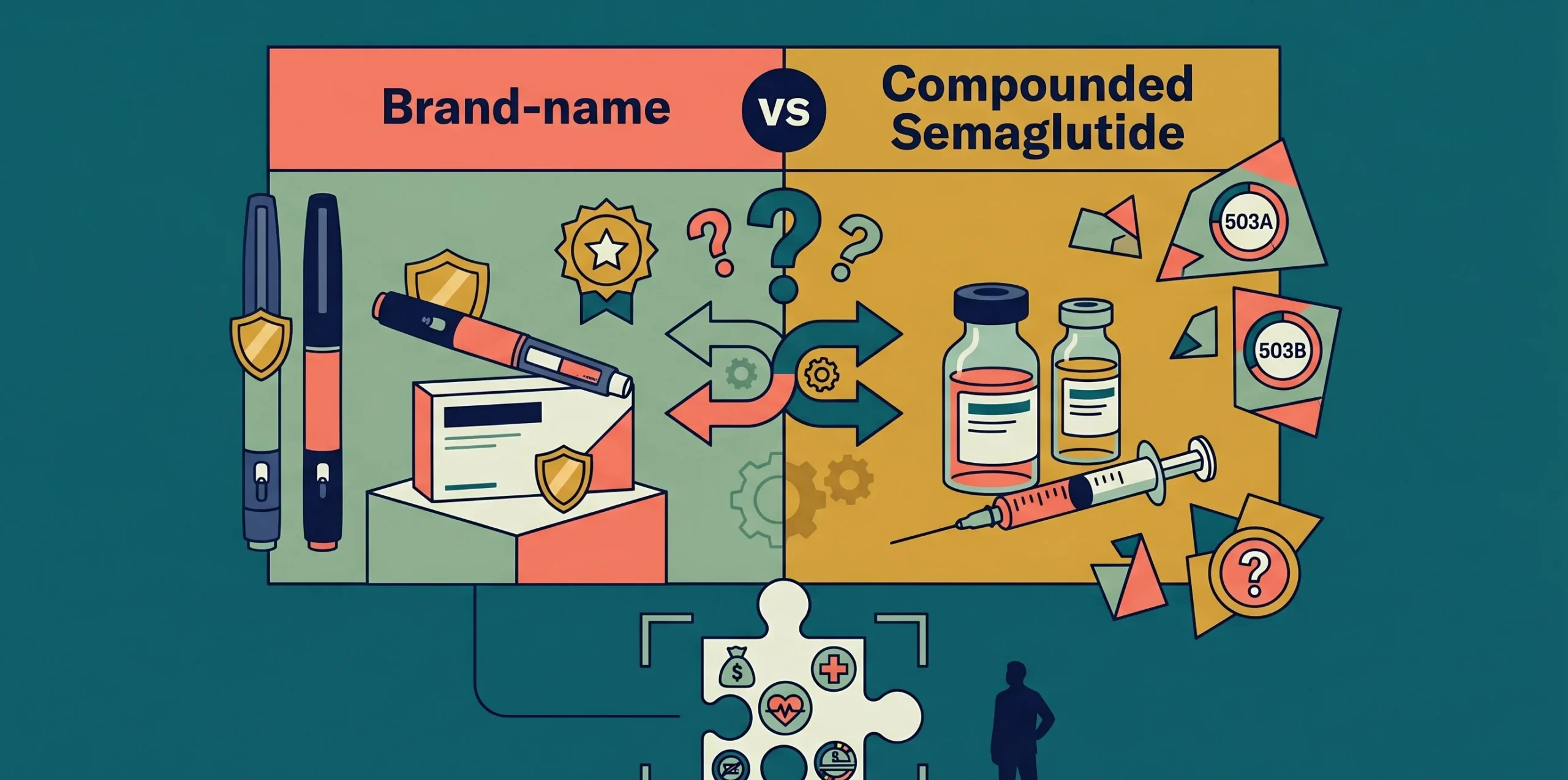
The semaglutide market has gone through three distinct phases in the past four years. From late 2021 through most of 2024, brand-name supply could not keep up with demand, the FDA placed the molecule on the shortage list, and licensed compounding pharmacies legally produced compounded versions for patients who could not access Ozempic or Wegovy. From late 2024 into 2025, the FDA declared the shortage resolved and began enforcement actions against compounders continuing to produce the drug. Through 2025 and into 2026, the landscape has settled into a more complicated reality where some compounded forms remain available under specific circumstances, others do not, and the patient-facing decision has become much harder to navigate without informed guidance.
If you are weighing compounded versus brand-name semaglutide right now, the simple answer of two years ago does not apply. Here is what the current framework actually looks like and what to ask before agreeing to either.
The Molecules in Question
Semaglutide is the active pharmaceutical ingredient in three FDA-approved brand-name products. Ozempic is approved for type 2 diabetes management. Wegovy is approved for chronic weight management in qualifying patients. Rybelsus is the oral form approved for type 2 diabetes.
Tirzepatide is a related but distinct molecule, the active ingredient in Mounjaro (diabetes) and Zepbound (weight management). It is a dual GLP-1 and GIP receptor agonist. The comparison between these molecules and how they perform clinically is covered in our GLP-1 medications comparison post.
The conversation in this post focuses on semaglutide specifically because the compounding landscape and the regulatory history are different for tirzepatide. For tirzepatide, the tirzepatide weight loss page covers the program specifics.
The 503A and 503B Distinction
The FDA recognizes two categories of compounding pharmacies, and the distinction matters for what a patient is actually receiving.
503A compounding pharmacies are state-licensed and produce compounded medications for individual patients with valid prescriptions. They operate under state pharmacy law with FDA oversight on specific issues. They cannot produce drugs in bulk for office stock or for distribution outside of patient-specific prescriptions.
503B outsourcing facilities are federally registered and inspected by the FDA. They follow current Good Manufacturing Practice (cGMP) standards and can produce sterile compounded medications in larger quantities for office use. They are subject to a higher regulatory standard than 503A pharmacies.
For semaglutide during the shortage period, both 503A and 503B pharmacies legally produced compounded versions under specific FDA guidance. When the shortage was resolved, the rules tightened. The current framework allows for some patient-specific compounding under certain clinical circumstances (for example, when the FDA-approved drug is medically inappropriate for a specific patient for documented reasons), but routine compounding of semaglutide for general weight management is much more restricted than it was during the shortage.
The 2024 to 2026 Timeline
The shortage timeline is worth understanding because it shapes what is legal and available right now.
The FDA placed semaglutide on the shortage list in 2022, citing demand exceeding supply. This activated provisions under FD&C Act Section 503A and 503B that allowed compounders to produce the drug while the shortage persisted.
Through 2023 and 2024, the compounded market grew substantially. Telehealth companies built business models around compounded semaglutide. Some operated responsibly, with clinical evaluation, follow-up, and proper sourcing documentation. Others operated as essentially mail-order pharmacies with minimal medical oversight.
In late 2024, the FDA declared the semaglutide shortage resolved. This declaration triggered the unwinding of the broad compounding allowances. Novo Nordisk, the brand-name manufacturer, pursued legal action against several large compounders and against telehealth companies marketing compounded semaglutide.
Through 2025, the regulatory and legal picture continued to evolve. Some compounders shifted to producing semaglutide salts (a chemically related but distinct form) that the FDA explicitly classified as not FDA-approved and not appropriate as substitutes. Other compounders shut down their semaglutide programs entirely. A subset of legitimate 503A pharmacies continued producing patient-specific compounded versions under narrower clinical justifications.
For patients in 2026, the practical situation is that compounded semaglutide is still available through some channels, but the quality, legality, and clinical appropriateness varies enormously by source. This is not the same market it was in 2023.
What to Look For in Any Compounded Product
If you are considering compounded semaglutide through a legitimate channel, there are specific questions that separate a responsible pharmacy from a questionable one.
The source of the active pharmaceutical ingredient (API). The API should be sourced from an FDA-registered facility with documented Certificates of Analysis showing identity, purity, and potency. The pharmacy should be able to share this documentation.
The salt form. FDA-approved semaglutide is the specific form Novo Nordisk uses. Some compounders have used different salts (semaglutide sodium, semaglutide acetate) that the FDA has explicitly stated are not equivalent and not appropriate substitutes. The salt form should match the FDA-approved version.
The pharmacy licensing. The pharmacy should be licensed in your state, in good standing, and (for sterile preparations) ideally accredited by relevant bodies. Look up the pharmacy directly with your state board of pharmacy.
The sterility documentation. Injectable products require sterility testing and documentation. A reputable compounding pharmacy can describe their sterility assurance process.
Additives. Some compounded semaglutide products include B12, B6, or other additives. There may or may not be clinical justification for these. The patient should know what is in the vial and why.
The clinical pathway. The product should be prescribed after a real clinical evaluation, not after a five-minute web form. The provider should be a licensed clinician with prescribing authority in your state. There should be a real plan for follow-up and monitoring.
If any of these elements is missing or vague, the product source is questionable regardless of how the marketing pages describe it.
The Cost Reality
The compounded versus brand-name decision often comes down to cost, and the cost picture in 2026 is more variable than it used to be.
Brand-name Wegovy and Zepbound continue to be expensive at retail. Insurance coverage for weight management indications has improved in some plans but remains inconsistent, and prior authorization requirements vary widely. For patients whose insurance does not cover the brand-name drug, the out-of-pocket cost is meaningful.
Compounded semaglutide is generally less expensive than the brand-name equivalent, though the gap has narrowed since 2023. The pricing also varies more between sources than it used to. Some legitimate compounding pharmacies charge prices that reflect their actual production costs and quality standards. Some questionable sources are priced suspiciously low.
A reasonable assumption is that significant price differences from the median market price probably reflect either a quality difference or a marketing tactic. Neither is good for the patient.
Why the Decision Belongs in a Clinical Conversation
The reason this is not a simple “compounded versus brand” decision is that the right answer depends on several patient-specific factors.
The clinical indication matters. A patient with type 2 diabetes has access to insurance-covered Ozempic in most cases. A patient with weight management as the primary indication has different insurance dynamics. A patient using GLP-1 medications for metabolic optimization at sub-therapeutic doses is in a different conversation, which we cover in the microdosing GLP-1 post.
The risk tolerance matters. Some patients are more comfortable with the FDA-approved supply chain. Others are willing to accept the variability of compounded products if the price difference is meaningful and the source is verified.
The supply situation matters. If the brand-name drug is available and affordable through insurance, the case for compounded versions is much weaker. If the brand-name drug is unaffordable and the patient meets clinical criteria for treatment, a legitimate compounded source may be the appropriate path.
The follow-up plan matters. A medication taken without proper clinical monitoring is a different proposition than the same medication taken with documented dose titration, side effect management, and outcome tracking. The medication is part of the program. The program is what determines outcomes.
How Our Program Approaches This
At Towsen Clinic, the semaglutide question is handled inside a structured medical weight management program. The clinical evaluation comes first. The decision about which formulation to use is made based on insurance coverage, clinical appropriateness, and the patient’s specific situation. Follow-up monitoring and dose adjustment are built into the program rather than left to the patient to figure out on their own.
We do not market compounded semaglutide as a generic budget version of the brand-name drug. We treat the medication choice as a clinical decision that has to fit the patient’s broader health picture. We also keep current with the evolving regulatory landscape because it directly affects what is available and appropriate at any given point in time. The full program structure is on the weight management therapy page.
The Honest Position
The compounded versus brand-name semaglutide question does not have a single correct answer. There are situations where the brand-name drug is the right choice. There are situations where a properly sourced compounded version from a licensed pharmacy is a reasonable choice. There are also situations where the product being marketed online is not safe or legal to use, regardless of how the website presents it.
The patient cannot easily distinguish these situations on their own. That is the actual problem with the current market. If you are considering GLP-1 therapy and you want a clinical pathway that takes the formulation question seriously, schedule a consultation and we will work through the options that actually apply to your situation.