
If you have been following peptide therapy, you have probably heard some version of “the FDA banned peptides.” The reality is more complicated and more fluid than a ban, and the details matter if you want to understand what your clinic can legally offer you.
The short version: several widely used peptides were placed in a restricted regulatory category over the past couple of years, some were removed from that restriction in 2026, and a formal review process is actively underway to decide which peptides can be legally compounded going forward. The situation is genuinely in motion, with a key advisory committee meeting scheduled for late July 2026. What follows is a clear picture of the framework, the timeline, and what it means for you as a patient.
The Regulatory Framework, Briefly
To understand the news, you need to understand a few categories.
FDA-approved drugs have gone through full clinical trials and received approval for specific uses. Among peptides, this includes semaglutide, tesamorelin (brand name Egrifta, for HIV-associated fat redistribution), and a handful of others. These can be prescribed for their approved uses and, at a physician’s judgment, off-label.
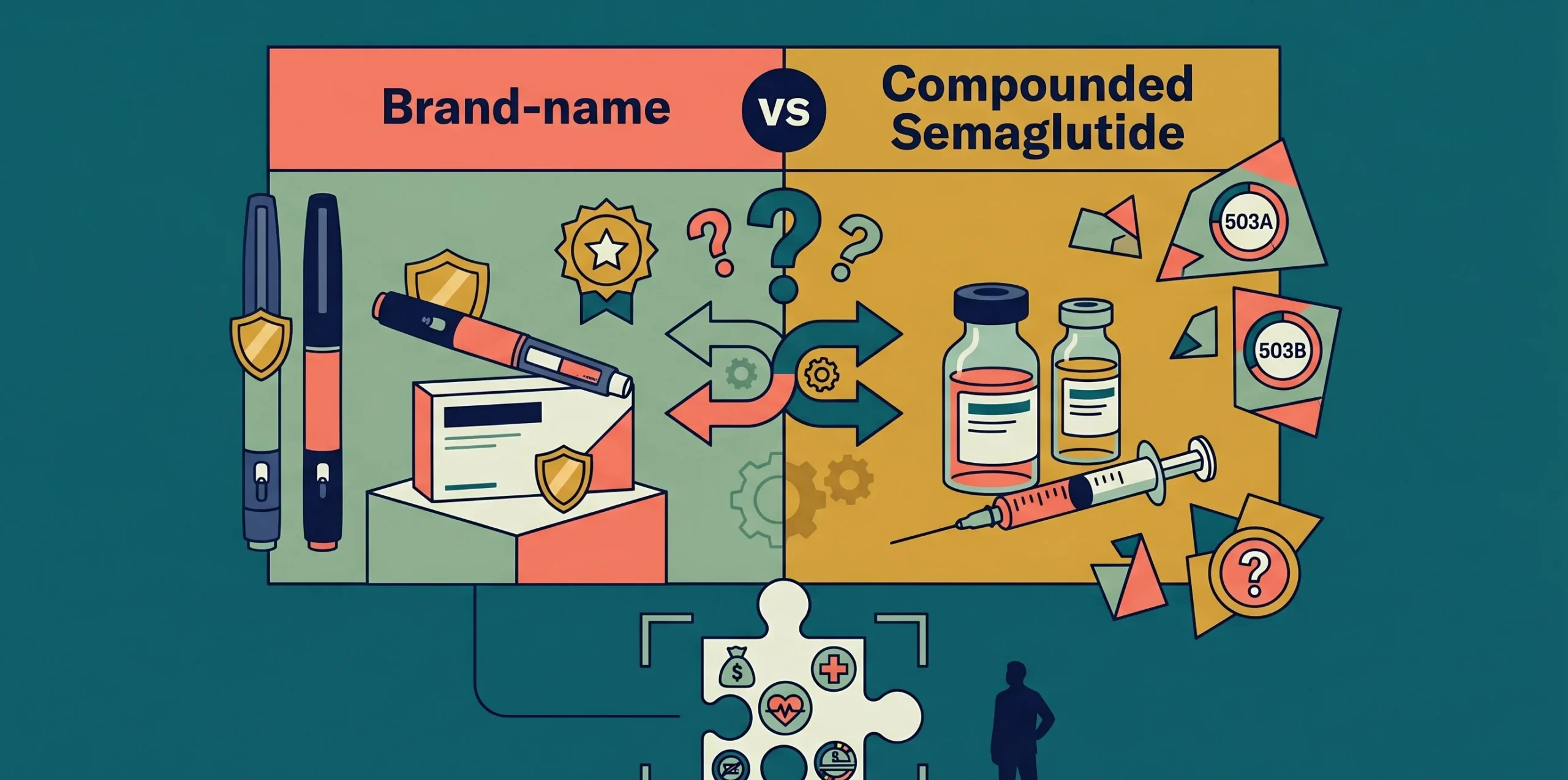
Compounded medications are prepared by specialized pharmacies for individual patients. There are two types of compounding facility. A 503A pharmacy is state-licensed and compounds patient-specific prescriptions. A 503B outsourcing facility is federally registered, follows stricter manufacturing standards, and can produce compounded medications in larger batches. Many peptides have historically been available through these compounding channels rather than as FDA-approved drugs.
The 503A bulk drug substances list is the key document here. It governs which raw ingredients (bulk substances) a 503A pharmacy may use to compound when there is no FDA-approved version. The FDA sorts nominated substances into categories. One category effectively permits compounding. Another category flags substances with enough safety questions that compounding is restricted while the FDA evaluates them. The Pharmacy Compounding Advisory Committee (PCAC) reviews substances and makes recommendations to the FDA about where they should land.
The distinction that trips people up: being removed from a restricted category is not the same as being approved for compounding, and neither is the same as FDA drug approval. These are three separate things, and a peptide can be in a gray zone between them.
The Timeline
Here is roughly how the situation has unfolded.
Over the past couple of years, the FDA placed a number of widely used peptides into the restricted category of the 503A bulks list, citing safety concerns that included questions about impurities and characterization. This affected several peptides that clinics and patients had been using, and it created uncertainty about what could still be compounded.
In April 2026, the FDA removed a group of peptides from that restricted category, following the withdrawal of their nominations. This was widely reported as good news for peptide access, but it came with an important caveat. Removal from the restricted category did not automatically place these peptides on the permitted-for-compounding list. It left several of them in a gray zone: no longer flagged as restricted, but not affirmatively cleared for compounding either, and still not FDA-approved.
For late July 2026, the FDA scheduled a PCAC meeting to review several peptides for potential inclusion on the 503A bulks list, which would formally address their compounding eligibility. The committee’s role is to review the clinical data and make recommendations, after which the FDA makes its determination. As of this writing, that review is upcoming and the outcomes are not yet known. Additional peptides are slated for review at a later meeting.
The practical takeaway is that peptide regulatory status in 2026 is a moving target. Any specific claim about what is or is not compoundable should be verified against the current FDA position at the time you are actually considering treatment, because the status of individual peptides has changed more than once and further changes are pending.
What This Means for Specific Peptides
Because the situation is evolving, the most honest thing a clinic can tell you is the general standing of each peptide and the fact that it requires current verification. Here is the broad picture.
Sermorelin occupies a relatively stable position. It was previously an FDA-approved product (marketed as Geref, a diagnostic agent) before the manufacturer voluntarily withdrew it from the market. That prior-approval history gives it a stronger legal basis for compounding under 503A, and it has remained one of the most commonly compounded peptides. It is used off-label for growth hormone support. It is not currently FDA-approved for that off-label use, but its compounding availability has been more consistent than most other peptides.
Tesamorelin is FDA-approved (brand name Egrifta) for HIV-associated fat redistribution. Because it is an approved drug, its status is the clearest of any peptide in this space. Its off-label use in other populations is a separate clinical conversation, which we cover in the post on tesamorelin for visceral fat.
BPC-157, TB-500, CJC-1295, ipamorelin, and several others have been the subject of the shifting regulatory picture described above. Their compounding status has changed during 2026 and remains subject to the ongoing PCAC review process. This is exactly the category where current verification matters most, and where a responsible clinic will be transparent about the uncertainty rather than making confident claims that could be outdated. We cover the growth hormone peptides specifically in the comparison of sermorelin, ipamorelin, and CJC-1295.
The Risk of “Research-Grade” Peptides Online
One consequence of the tightening and uncertainty around compounded peptides is that some patients turn to peptides sold online as “research chemicals,” often labeled “not for human consumption.” This is a serious mistake, and it is worth being direct about why.
These products have no clinical oversight. There is no prescriber evaluating whether the peptide is appropriate for you, no monitoring, and no one managing side effects or interactions.
Quality and purity are unverified. Products sold outside the regulated pharmacy system have been found to be mislabeled, underdosed, overdosed, or contaminated. You do not actually know what is in the vial. For an injectable product, contamination is a real safety hazard.
The legal position is murky and buyer-dependent. Products sold “for research use only” and then used by humans sit outside the framework designed to protect patients. The disclaimers are a legal shield for the seller, not a safety assurance for you.
The gap between a peptide obtained through a licensed pharmacy with a prescription and clinical oversight, and a peptide bought from an online vendor, is enormous. The molecules might share a name. Everything else about the safety picture is different.
Legitimate Alternatives When a Peptide Becomes Unavailable
When a previously available peptide becomes harder to obtain through legitimate channels, there are usually reasonable alternatives that a knowledgeable clinician can turn to.
FDA-approved analogs sometimes exist. Tesamorelin, for example, is an FDA-approved growth hormone-releasing hormone analog that can serve a role for certain goals, as we discuss in the tesamorelin post.
Different-mechanism peptides that remain available may accomplish a similar clinical goal. Sermorelin’s more stable standing makes it a common fallback for growth hormone support when other options tighten.
Non-peptide approaches often address the same underlying goal. Many patients pursuing peptides for body composition, recovery, or metabolic health can make substantial progress with the hormone optimization, weight management, and lifestyle interventions that form the foundation of good care regardless of peptide availability.
The point is that responsible peptide therapy is not dependent on any single molecule. A clinic that treats peptides as one tool among many can adapt when the regulatory landscape shifts, rather than pushing patients toward gray-market sources to keep a specific peptide going.
How a Responsible Clinic Handles Peptides in 2026
Given the fluid regulatory environment, a responsible clinic does a few specific things.
It verifies current status before prescribing. What was compoundable last year may not be this year, and vice versa. The clinic checks the current position rather than relying on old information.
It sources only through licensed pharmacies. Legitimate 503A and 503B pharmacies with quality documentation, not gray-market vendors.
It documents the clinical rationale and informs the patient. You should understand whether what you are receiving is FDA-approved, compounded under 503A, off-label, or something else, and what that means.
It monitors treatment. Baseline labs, follow-up testing (IGF-1 and glucose for growth hormone peptides, for example), and side effect surveillance.
It adapts when the landscape changes. If a peptide becomes unavailable, the clinic has alternatives rather than pushing the patient toward unregulated sources.
This is the approach we take at Towsen Clinic, detailed on the advanced peptide therapy page. The foundational science of how these peptides work is covered in our earlier physician’s guide to peptide therapy.
The Bottom Line
The FDA has not simply “banned peptides.” It has been sorting them through a regulatory process that is still underway, with a significant review scheduled for late July 2026 and more to follow. Some peptides are FDA-approved, some have a stable compounding basis, and some are in a shifting gray zone that requires current verification.
What you should take away as a patient: peptide therapy can still be pursued legitimately in 2026, but it requires a clinic that tracks the current regulatory position, sources through licensed pharmacies, and is honest about what is and is not settled. It also requires avoiding the online “research chemical” market entirely.
If you are considering peptide therapy and want to understand your actual legitimate options given the current landscape, schedule a consultation and we will walk through what is available and appropriate for your goals.