
A man in his late 30s has clear low testosterone symptoms. Fatigue, low drive, brain fog, declining strength. He also wants to have a child in the next few years. He brings both facts to his doctor, and the response is some version of “let’s hold off on testosterone until you’re done having kids.” So he waits, sometimes for years, living with symptoms that have a treatment, because he was told the treatment would cost him his fertility.
The concern is legitimate. Standard testosterone therapy does suppress sperm production, often dramatically. But the conclusion that he must choose between treatment and fertility is wrong. There are protocols designed specifically for men in this exact situation. Most primary care clinicians do not discuss them, and a lot of men miss out on treatment they could safely have.
This post explains why standard testosterone therapy suppresses fertility, how recovery works, and the fertility-friendly alternatives that let men address low testosterone while protecting their ability to have children.
How the Body Controls Testosterone and Sperm Together
To understand the fertility problem, you have to understand the signaling system that runs both testosterone and sperm production. It is called the hypothalamic-pituitary-gonadal axis, or HPG axis.
The hypothalamus in the brain releases a signal (GnRH) that tells the pituitary gland to release two hormones: luteinizing hormone (LH) and follicle-stimulating hormone (FSH). LH travels to the testes and tells specific cells to produce testosterone. FSH travels to the testes and supports sperm production. Both signals come from the same upstream system, and both are needed for the testes to function fully.
The important detail is that sperm production depends on high testosterone concentrations inside the testes, much higher than the levels in your blood. That high intratesticular testosterone is produced locally in response to LH. So the brain’s signal drives both blood testosterone and the local testicular environment that sperm production requires.
Why Standard Testosterone Therapy Shuts Sperm Down
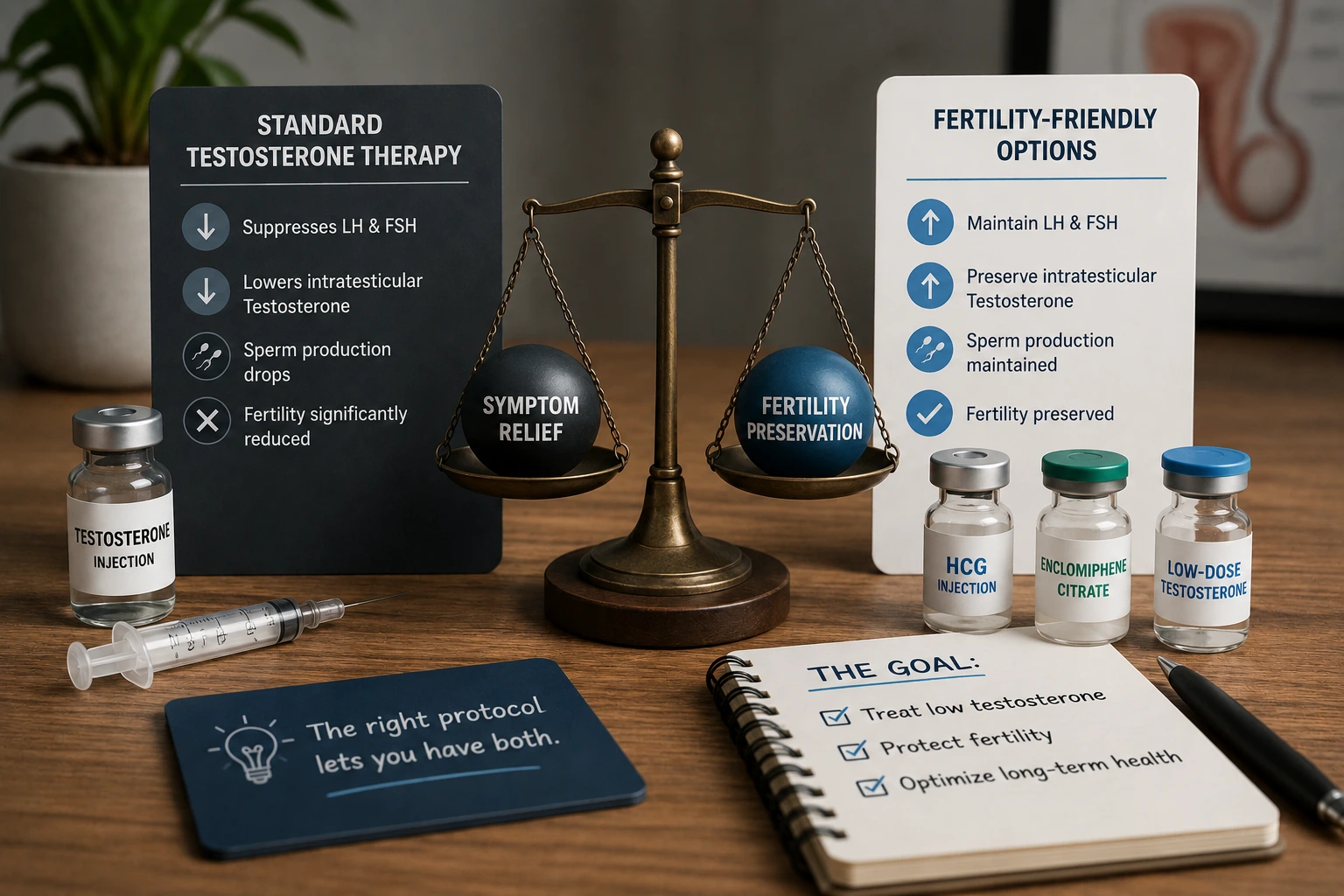
When you take testosterone from an outside source (injections, gels, pellets), your blood testosterone rises. The brain detects this through a feedback loop and concludes that the body has plenty of testosterone, so it reduces its own signal. GnRH drops, which means LH and FSH drop.
This is where fertility suffers. When LH falls, the testes stop producing their own testosterone, and intratesticular testosterone collapses. When FSH falls, the direct support for sperm production disappears. The high local testosterone concentration that sperm production needs is gone, even though blood testosterone is high from the external source. The result is that sperm production drops, often severely.
For most men on standard testosterone therapy, sperm counts decline significantly within months. In a substantial portion of men, sperm counts drop to zero or near zero. The blood testosterone is high and the symptoms improve, but fertility is suppressed because the body’s own testicular machinery has been switched off. This is not a rare side effect. It is the expected consequence of how the feedback system works.
The Recovery Question
The good news is that for most men, fertility recovers after stopping testosterone therapy. The brain’s signal resumes, LH and FSH return, and the testes restart their own testosterone and sperm production.
The honest part is that recovery is not instant and not guaranteed for everyone. The timeline ranges widely, from a few months to over a year, and depends on factors including age, how long therapy was used, and individual variation. A minority of men experience prolonged suppression or do not fully recover their baseline fertility, particularly with longer durations of therapy or in men who had reduced fertility to begin with.
This uncertainty is exactly why the fertility conversation needs to happen before starting therapy, not after. A man who starts standard testosterone therapy without understanding the fertility implications can find himself in a difficult position if his family plans change or if recovery is slower than expected.
The Fertility-Friendly Alternatives
For men who want to treat low testosterone while preserving fertility, several protocols work with the HPG axis rather than shutting it down. These are real, available options that a knowledgeable clinician can use.
Enclomiphene citrate stimulates the body’s own testosterone production rather than replacing it. It works at the level of the brain, blocking estrogen feedback so the pituitary releases more LH and FSH. The result is increased natural testosterone production with preserved (and sometimes improved) sperm production, because the testicular machinery stays active. Enclomiphene is the active component of clomiphene, refined to the enantiomer most responsible for the testosterone-raising effect. It has been studied in male hypogonadism and is a leading option for men who want symptom relief without fertility suppression.
HCG (human chorionic gonadotropin) mimics LH. It directly stimulates the testes to produce testosterone and maintains the high intratesticular testosterone that sperm production needs. HCG can be used on its own to raise testosterone while keeping the testes active, which preserves fertility in a way that standard testosterone therapy cannot.
HCG plus low-dose testosterone therapy is a combination protocol used specifically in this patient population. The testosterone provides symptom relief, while the HCG keeps the testes functioning and maintains intratesticular testosterone. This approach lets some men get the benefits of testosterone therapy while substantially reducing the fertility impact, though it requires careful clinical management.
Aromatase inhibitors like anastrozole or letrozole are used in selected cases, particularly in men whose low testosterone is accompanied by high estradiol. By reducing the conversion of testosterone to estrogen, these medications can shift the hormonal balance and, in the right candidate, raise testosterone while preserving the HPG axis. This is a more specific intervention appropriate only for certain men. The estrogen balance in men is a topic in itself, which we cover in the post on estrogen in men on testosterone therapy.
The right protocol depends on the man’s hormone profile, his fertility timeline, and his symptoms. There is no single answer that fits everyone, which is the whole point of a real evaluation rather than a blanket “wait until you’re done having kids.” We go deeper into how these options compare in the post on HCG, enclomiphene, and testosterone choices.
The Sperm Banking Conversation
Even for men choosing a fertility-friendly protocol, banking sperm before starting any hormonal treatment is worth discussing. It provides a safeguard. If fertility is more affected than expected, or if family plans accelerate, banked sperm offers a backup that does not depend on the testes recovering on any particular timeline.
Sperm banking involves logistics and cost, and insurance coverage varies. For a man who places high value on future fertility, it is a reasonable form of insurance to weigh before committing to a treatment path. A clinician evaluating your situation should raise this option as part of the conversation.
What an Evaluation Looks Like
For a man weighing testosterone therapy against family planning, a proper evaluation includes a full hormone panel (total and free testosterone, SHBG, LH, FSH, estradiol, and related markers), a discussion of his fertility timeline and how firm those plans are, and a baseline semen analysis in many cases to establish where his fertility stands before any treatment.
From there, the conversation is about matching the protocol to the goals. A man who wants a child within a year is in a different situation than a man whose plans are five years out. A man with already-reduced fertility needs different handling than a man with normal baseline sperm parameters. The full picture drives the decision. The testosterone evaluation itself follows the same principles we covered in the post on total versus free testosterone, since interpreting the hormone panel correctly is the foundation for any treatment choice.
An Important Caveat
This post is about preserving fertility in men who have low testosterone symptoms and want treatment. It is not a substitute for a reproductive endocrinologist or fertility specialist when active fertility problems exist. A man and his partner who are actively struggling to conceive need a fertility workup that goes beyond the scope of testosterone management. The protocols here help men avoid causing a fertility problem with their testosterone treatment. They are not a treatment for existing infertility, which requires specialized evaluation.
The Bottom Line
You do not have to choose between treating low testosterone and protecting your fertility. The blanket advice to wait until you are done having children ignores a set of protocols designed precisely for men in this situation. Standard testosterone therapy suppresses sperm production, but enclomiphene, HCG, and combination approaches offer paths that address symptoms while keeping the testicular machinery active.
If you have low testosterone symptoms and plan to have children, schedule a consultation and we will work through the options that let you treat the problem without giving up your fertility.