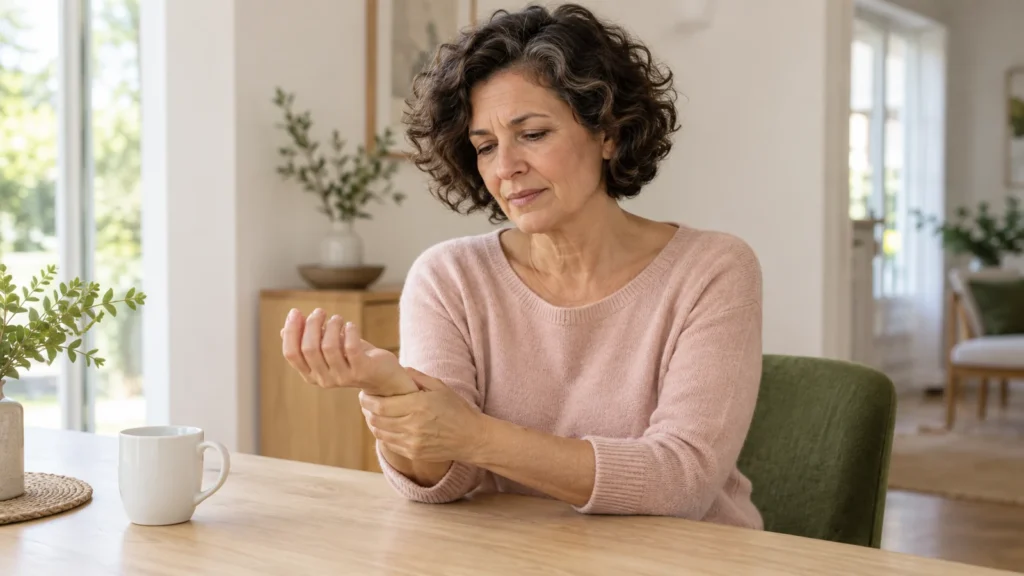
Menopause Joint Pain: Why Your Joints Ache and What Helps
Aching joints are one of the most common complaints around menopause. This guide covers the estrogen link, other causes to rule out, what helps,
Read the article
Injury and Recovery · 6 min read
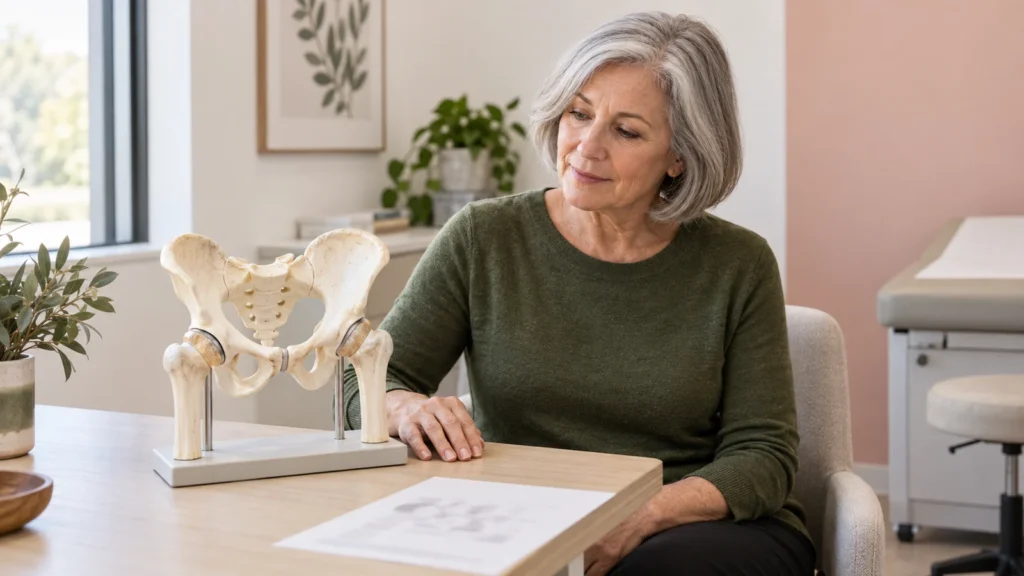
Bone loss after menopause speeds up because estrogen drops, and the Endocrine Society explains that estrogen slows the natural breakdown of bone. Up to 20 percent of bone density can go in the five to seven years after menopause, says the Bone Health and Osteoporosis Foundation. Osteoporosis is a silent disease, the National Institutes of Health says, because there are usually no symptoms until a bone breaks.
Estrogen protects bones, and it drops sharply at menopause, according to the Bone Health and Osteoporosis Foundation. That drop can cause bone loss, the foundation says.
For many women, osteoporosis starts to develop a year or two before menopause, according to the National Institutes of Health. It is a disease that makes bones weak and brittle, so they break more easily.
Women of every race can get osteoporosis, and the National Institutes of Health lists these factors that can raise the risk.
If you take a medicine like that, ask the doctor who prescribed it about your bones.
The US Preventive Services Task Force recommends screening for osteoporosis in women 65 and older, in advice updated in January 2025. It also recommends screening for women under 65 who are past menopause and at higher risk of a fracture.
For those younger women, it suggests two steps.
A DXA scan is the most common test, and the National Institutes of Health describes it as quick and painless. It usually measures the hip and spine, the bones that break most often.
After menopause, the result comes back as a T-score. Minus 1 or higher means healthy bone, the same source says, and minus 2.5 or lower means you might have osteoporosis. Scores in between mean osteopenia, a milder form of low bone density.
The National Institutes of Health says weight-bearing exercise and a diet rich in calcium and vitamin D can help prevent osteoporosis and fractures. Women should also limit alcohol to one drink a day and avoid smoking, it advises.
A mix of these three is best for bones and for preventing falls and fractures, the same source says.
Brisk walks around West Chester count as weight-bearing exercise. For older adults, the same source says exercise can build muscle and balance. That can help prevent falls, even though exercise no longer adds bone mass at that age.
With low bone density or osteoporosis, talk to your doctor before starting a new exercise program. People with osteoporosis should avoid high impact exercise, per the same source.
The National Institutes of Health lists 1,200 milligrams of calcium a day for women over 50. Vitamin D needs are 600 IU a day up to age 70 and 800 IU a day after that.
Milk, cheese and yogurt are the best food sources of calcium, per the same source. Sardines, canned salmon, kale and tofu made with calcium add more.
Few foods have vitamin D, though salmon, trout and tuna have some, and most milk in the United States has it added. Talk to your doctor before you start a calcium or vitamin D supplement.
The CDC says falls caused 88 percent of emergency visits and hospital admissions for hip fractures in 2019. Women have about 70 percent of the hip fractures treated in an emergency room or hospital, per the same page.
To lower your risk, the CDC suggests these steps.
Some menopause hormone therapies are “approved to prevent osteoporosis (bone weakening),” the FDA said in November 2025.
One estradiol skin patch has an FDA label that sets a limit when bone is the only reason. Doctors should “first consider the use of non-estrogen medications,” the label says. “Consider estrogen therapy only for women at significant risk of osteoporosis,” it adds.
The FDA has approved drugs with hormones identical to the ones women’s bodies make in their reproductive years. It also says many products sold as “bioidentical hormones” are compounded drugs, and compounded drugs are not FDA approved. That means no compounded hormone is FDA approved to prevent osteoporosis.
Hormone therapy “is not for everyone,” the FDA says. For some women it may raise the chance of blood clots, heart attacks, strokes, breast cancer or gallbladder disease.
Talk to your doctor soon if you have any of these.
After a fall, sharp pain in the groin or upper thigh, or not being able to stand, needs emergency care. The American Academy of Orthopaedic Surgeons lists those as signs of a broken hip.
Adrienne Towsen, MD, is an orthopedic surgeon, and the American Board of Orthopaedic Surgery certified her in 2006. Her training includes a sports medicine fellowship at Thomas Jefferson University Hospital.
She no longer performs surgery, and we do not do injections or physical therapy here. Our work covers hormone care, lab testing, and injury prevention that draws on her orthopedic background.
The clinic is at 795 East Marshall Street, Suite 303 in West Chester. It is on the third floor of the North Hills Medical Building, next door to Chester County Hospital. Patients come in from Exton, Malvern, Glen Mills, Wayne, King of Prussia and Newtown Square.
At 65 or older, or past menopause with a risk factor, ask your doctor about a DXA scan.
If hot flashes, poor sleep or other menopause symptoms bother you too, hormone care is worth a conversation. Our page on hormone therapy in West Chester, PA explains how Dr. Towsen builds a plan, starting with bloodwork and a full health history.
A first visit is 60 to 90 minutes and costs $295. You can see the steps and the lab list on our page on how the first visit works. Bring any DXA results you have.
Call (484) 803-5448 to book.
Aching joints are one of the most common complaints around menopause. This guide covers the estrogen link, other causes to rule out, what helps,
Read the article
Muscle, tendons, sleep and hormones all change after 40. This guide explains the research on each change, what helps recovery, and which signs need
Read the article
A plain guide to why knees hurt after 40, what the guidelines say helps, and the signs that mean a doctor should see your
Read the articleBook a visit at our West Chester office and bring your questions.
Book a consultation