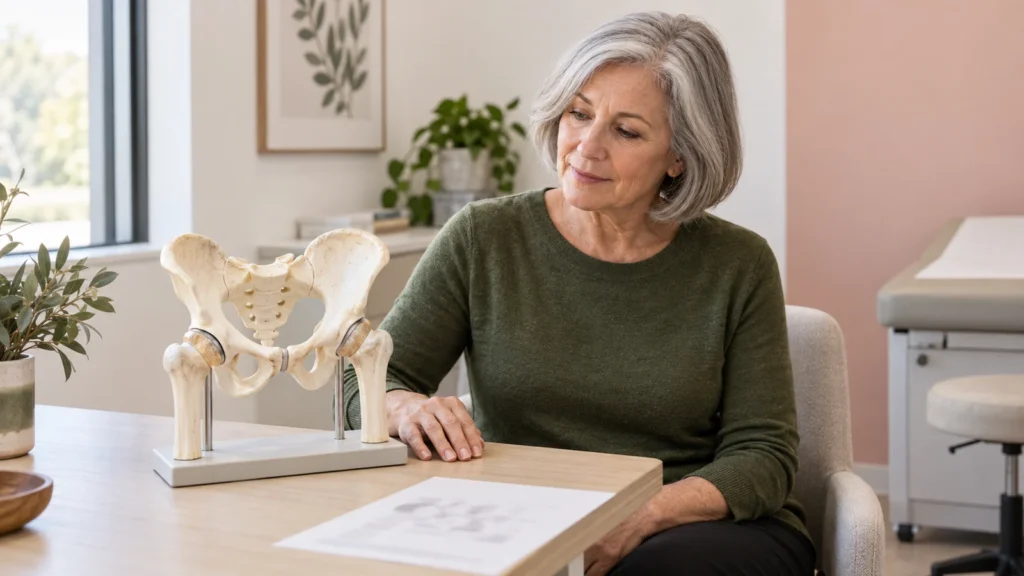
Bone Loss After Menopause: Why It Speeds Up and What Helps
A plain guide to why bones thin faster after menopause, who should get a DXA scan and when, and the everyday steps that help.
Read the article
Injury and Recovery · 3 min read
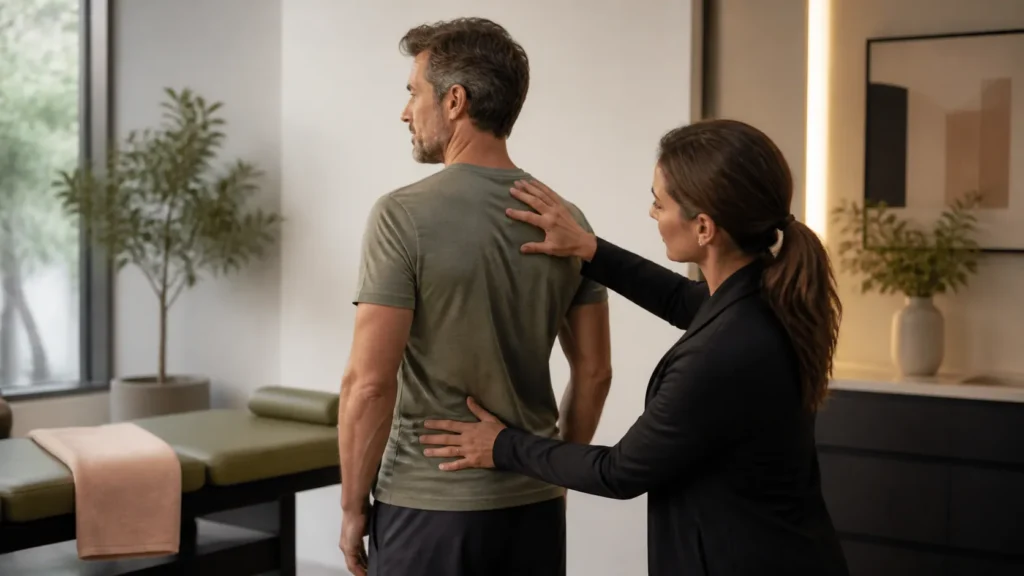
Most back pain gets better without a specialist. The American College of Physicians puts imaging and referral late for ordinary low back pain, behind movement, time and simple pain control. A small group of symptoms needs care the same day, so those come first.
Call a doctor today, or go to an emergency department, if any of these appear:
Doctors call these red flags. The first two together can point at pressure on the nerve roots at the base of the spine, which is treated as a surgical emergency.
A specialist opinion earns its place in three situations. The pain has a nerve pattern, it has not improved over six weeks of sensible activity, or a red flag has appeared. Pain that travels below the knee in a stripe, with numbness or weakness, is the nerve pattern.
Ordinary back pain that moves around, eases with walking and flares after a long drive is a different animal. That one usually improves without anyone specialized.
For most people no single structure gets blamed. Guidelines call it non specific low back pain. The label sounds unhelpful, and it describes the limits of what a scan can show.
The muscles, discs, joints and nerves in a lower back are packed close together. Pain from one of them refers into the territory of another. So the plan counts for more than the label.
For ordinary back pain in the first six weeks, without red flags, the answer is usually no. The American College of Physicians and the Choosing Wisely program both advise against routine early imaging.
The reason is worth knowing. Scans of people with no pain at all commonly show bulging discs and worn joints.
So an early scan often finds something that was never the cause. A finding you did not need can lead to treatment you did not need.
Neck pain follows the same shape. Most of it settles with movement.
The red flags are the ones above, plus weakness or numbness spreading into a hand. A first ever severe headache and pain after a car crash also belong on that list.
Desk work is the common driver in Chester County. The fix is rarely a perfect chair. It is more movement, more often, and a load your neck is prepared for.
Adrienne Towsen, MD, is a board certified orthopedic surgeon. The American Board of Orthopaedic Surgery certified her in 2006, and her sports medicine fellowship is from Thomas Jefferson University Hospital.
She no longer performs surgery. Her focus now, in her own words when the clinic opened, is “prevention and health optimization” and “maximizing musculoskeletal potential and injury prevention”.
We do not do spinal surgery, injections or physical therapy here. The clinic works on the layer underneath. That means how you load your back, how well you recover, and the hormone and metabolic health that recovery depends on.
Towsen Clinic is in West Chester, on the third floor of the North Hills Medical Building beside Chester County Hospital. Most patients drive in from around the county, including Exton, Malvern, Glen Mills and Newtown Square.
If a red flag applies to you, stop reading and call your doctor today. If your back has been grumbling for months and nothing is getting worse, the useful question is what your body can be prepared for.
Our page on injury prevention and performance medicine in West Chester covers how we approach that.
A first visit is 60 to 90 minutes and costs $295. Our page on how the first visit works lists what it includes.
Call (484) 803-5448 to book.
A plain guide to why bones thin faster after menopause, who should get a DXA scan and when, and the everyday steps that help.
Read the article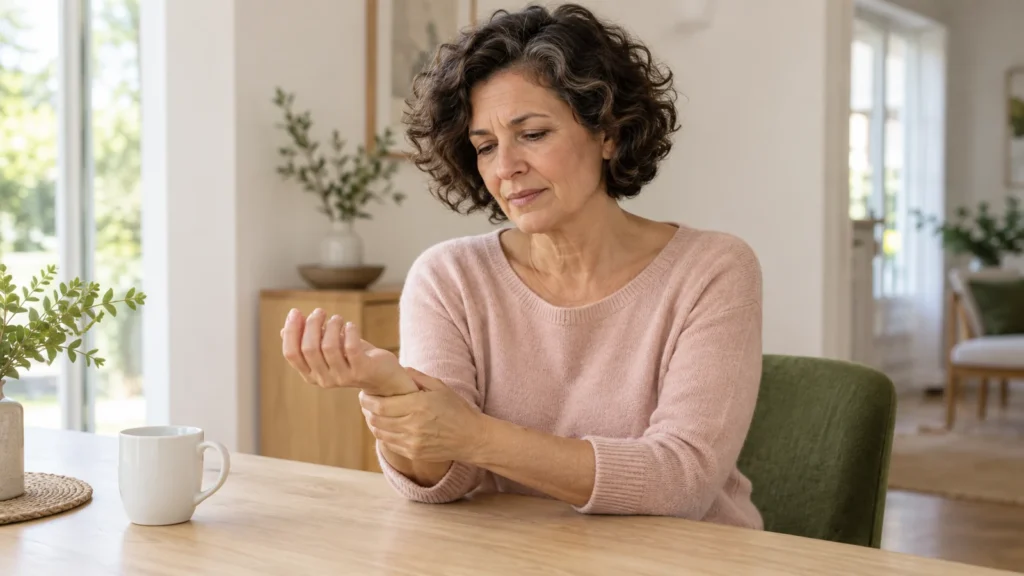
Aching joints are one of the most common complaints around menopause. This guide covers the estrogen link, other causes to rule out, what helps,
Read the article
Muscle, tendons, sleep and hormones all change after 40. This guide explains the research on each change, what helps recovery, and which signs need
Read the articleBook a visit at our West Chester office and bring your questions.
Book a consultation