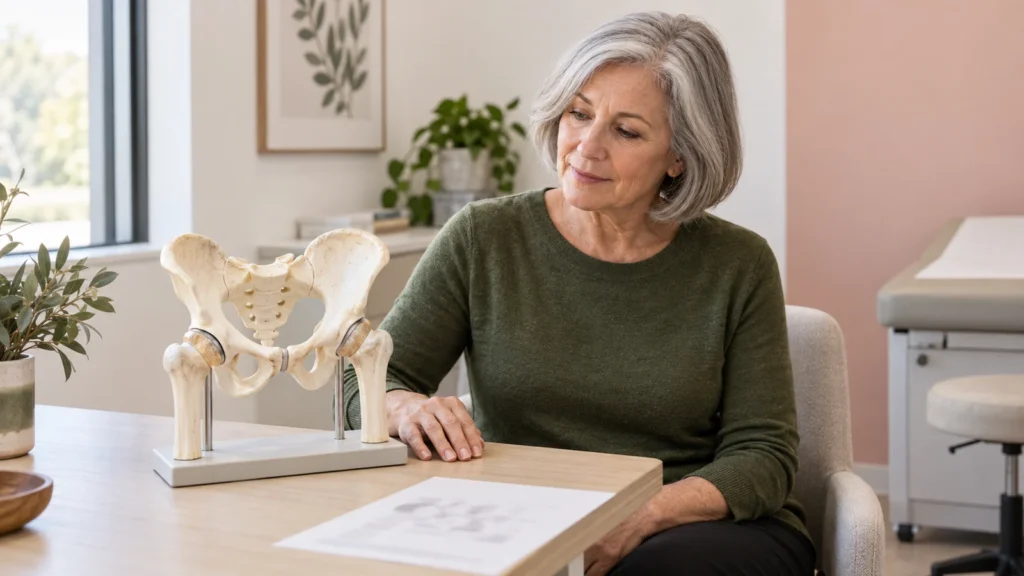
Bone Loss After Menopause: Why It Speeds Up and What Helps
A plain guide to why bones thin faster after menopause, who should get a DXA scan and when, and the everyday steps that help.
Read the article
Injury and Recovery · 6 min read

The American Academy of Orthopaedic Surgeons (AAOS) says frozen shoulder happens most often between ages 40 and 60, and more often in women than men. Those are the years around menopause, and researchers suspect falling estrogen plays a part. So far the research shows a possible link, and hormone therapy is not a treatment for frozen shoulder.
AAOS says frozen shoulder, or adhesive capsulitis, happens when the capsule around the shoulder joint thickens and tightens. Its main signs, AAOS says, are severe pain and a shoulder that will not move, on your own or with someone else’s help.
AAOS describes three stages, with these usual lengths.
AAOS adds that full recovery can take up to 3 years. Frozen shoulder can also come back, which AAOS calls uncommon, and the odds are higher when diabetes is present.
Beyond age 40 to 60 and being a woman, AAOS names these risk factors.
People with diabetes are more likely to develop frozen shoulder, according to a 2023 review in the journal BMJ Open. An earlier review, in the Muscles, Ligaments and Tendons Journal in 2016, estimated that 30 percent of people with frozen shoulder have diabetes. Its authors said doctors should consider testing for diabetes when frozen shoulder shows up.
For the thyroid, a 2023 review in the Journal of Shoulder and Elbow Surgery linked frozen shoulder mainly with an underactive thyroid. Women are much more likely than men to develop an underactive thyroid, says the National Institute of Diabetes and Digestive and Kidney Diseases.
Menopause may play a part, but AAOS says the causes of frozen shoulder are not fully understood. MedlinePlus, the health site of the National Library of Medicine, lists the hormone changes of menopause as a risk factor.
Duke University researchers suspected estrogen, because frozen shoulder is most common in women aged 40 to 60, the same age range as menopause. The Menopause Society notes that estrogen is involved in bone, muscle and connective tissue, and in reducing inflammation.
The Duke study used the health records of 1,952 women aged 40 to 60 who had gone through menopause. Frozen shoulder showed up in 7.65 percent of women without hormone therapy and in 3.95 percent of women on it.
Their paper, published in 2026 in the journal Climacteric, reported that the gap could be due to chance. The authors called their work a pilot study and asked for larger ones.
A link like this is an association: two things show up together, without proof that one causes the other.
Hormone therapy, often called HRT, is not a treatment for frozen shoulder. The FDA says it may help relieve hot flashes, night sweats, vaginal dryness and pain with sex, and may lower the chance of osteoporosis. Frozen shoulder is not on that list.
Anne Ford, MD, a coauthor of the Duke study, said in 2022: “Many menopause symptoms fall outside the FDA-approved indications for systemic hormone therapy, including those involving the musculoskeletal system”.
A trial at the University of California, San Francisco is comparing standard care with and without hormone therapy in women with frozen shoulder. Standard care there means a steroid shot and physical therapy. Its ClinicalTrials.gov listing, last updated in June 2026, shows it recruiting with no results posted.
AAOS says most people with frozen shoulder get better without surgery. It names physical therapy focused on shoulder flexibility as the main treatment, and it lists these options.
Our earlier post explains when shoulder pain needs a surgeon.
For people with diabetes, AAOS says working with their doctor on better blood sugar control can help a frozen shoulder recover faster. MedlinePlus says people with diabetes or thyroid problems are less likely to get frozen shoulder when those conditions are under control.
After a shoulder injury or surgery, AAOS says moving the shoulder early is one way doctors try to prevent frozen shoulder.
MedlinePlus lists two reasons for emergency care.
See a doctor soon for any of these.
The first three come from MedlinePlus. The American College of Rheumatology says the last one can be polymyalgia rheumatica, which is more common after 50. Headaches, vision changes or fever with that stiffness can signal giant cell arteritis, the college says, so tell your doctor.
Adrienne Towsen, MD, is a board certified orthopedic surgeon. The American Board of Orthopaedic Surgery certified her in 2006, and she finished a sports medicine fellowship at Thomas Jefferson University Hospital.
She no longer performs surgery, and we do not do injections or physical therapy here.
Our work looks at the health around the shoulder: how you move, your hormone levels and your metabolic health. Her own published focus, written when the clinic opened, is “maximizing musculoskeletal potential and injury prevention”.
Our standard lab panel includes thyroid tests and hemoglobin A1C, a blood sugar test. Thyroid disease and diabetes are both linked with frozen shoulder, so we read those results with your shoulder in mind.
Towsen Clinic is at 795 East Marshall Street, Suite 303 in West Chester, on the third floor of the North Hills Medical Building. The building is next door to Chester County Hospital. Patients come in from Exton, Malvern, Glen Mills, Wayne, King of Prussia and Newtown Square.
Get a stiff, painful shoulder diagnosed first. After that, look at the health around it: thyroid, blood sugar, hormone levels and movement.
Our page on injury prevention and performance medicine in West Chester explains how that work covers joint health, movement and lab work.
A first visit at Towsen Clinic is 60 to 90 minutes and costs $295. Our page on how the first visit works sets out the steps and the lab panel.
Call (484) 803-5448 to book a visit.
A plain guide to why bones thin faster after menopause, who should get a DXA scan and when, and the everyday steps that help.
Read the article
Aching joints are one of the most common complaints around menopause. This guide covers the estrogen link, other causes to rule out, what helps,
Read the article
Muscle, tendons, sleep and hormones all change after 40. This guide explains the research on each change, what helps recovery, and which signs need
Read the articleBook a visit at our West Chester office and bring your questions.
Book a consultation