
You hit 40. Maybe 45. And something shifted.
The energy that used to carry you through 12-hour days? Gone by 2 PM. The muscle you built in your 30s? Slowly disappearing, even though you still show up at the gym. Your focus at work? Scattered. Your drive at home? Quieter than it used to be.
You mention this to your doctor. They run bloodwork. And the response is almost always the same: “Your testosterone is within normal range.”
But here’s the problem. “Normal” doesn’t mean you feel good. And the range most labs consider normal is so wide that it’s almost meaningless when it comes to how you actually function day to day.
What Happens to Testosterone After 40
Testosterone levels drop gradually as men age. Starting around 30, most men lose about 1% of their total testosterone per year. By the time you’re 45, you may have 15% less than your peak. By 55, that number could be 25% or more.
This decline isn’t dramatic enough to trigger alarms on standard bloodwork. But it’s enough to change how you feel, how you perform, and how you show up in your career and relationships.
The symptoms tend to creep in slowly. Fatigue that builds week after week. A few extra pounds around the midsection that won’t budge. Trouble sleeping through the night. Less interest in things that used to excite you, including intimacy.
Most men don’t connect these dots right away. They blame stress, aging, or lack of discipline. But in many cases, declining testosterone is a major piece of the puzzle.
The Problem with ‘Normal’ Reference Ranges
When your doctor says your testosterone is “normal,” they’re comparing your number to a reference range. For most labs, that range is roughly 264 to 916 ng/dL for total testosterone.
Think about how wide that gap is. A 42-year-old executive and an 85-year-old retiree could both land inside that range and be called “normal.” But their energy levels, body composition, and daily function look nothing alike.
Reference ranges are built from population averages. They tell you whether your number is statistically common. They don’t tell you whether that number is right for your body, your age, or your goals.
This is where a lot of men get stuck. They feel terrible. Their bloodwork says they’re fine. And their doctor has no next step to offer because the lab result doesn’t flag anything.
Optimization medicine takes a different approach. Instead of asking “Is this number normal for the general population?”, the question becomes “Is this number where it needs to be for this person to feel and perform their best?”
Total Testosterone vs. Free Testosterone
Another issue with standard testing is that most doctors only check total testosterone. That’s a useful starting point, but it doesn’t tell the whole story.
Total testosterone measures everything in your blood, including the testosterone that’s bound to proteins and unavailable for your body to use. The number that matters more for how you feel is free testosterone, the small percentage that’s actually active and available.
A man can have a total testosterone level of 500 ng/dL and still feel awful if most of it is bound up and inactive. This is especially common in men over 40, because a protein called sex hormone-binding globulin (SHBG) tends to increase with age. More SHBG means more of your testosterone gets locked up.
That’s why thorough hormone testing looks at the full picture: total testosterone, free testosterone, SHBG, estradiol, and other markers that affect how your hormones actually work in your body.
Signs Your Testosterone May Be Below Your Personal Optimum
Not every man with suboptimal testosterone has the same symptoms. But certain patterns show up consistently:
Persistent fatigue that doesn’t improve with sleep or rest. You wake up tired and stay tired all day, regardless of how many hours you logged.
Increased body fat, especially around the abdomen. You’re eating the same way and exercising the same amount, but your body composition keeps shifting in the wrong direction.
Reduced muscle mass and strength. Workouts feel harder. Gains come slower. Recovery takes longer.
Brain fog and difficulty concentrating. Tasks that used to be automatic now require more effort. You lose your train of thought mid-sentence.
Low motivation and mood changes. The drive and ambition you’ve always relied on feels dimmer. You may feel flat, irritable, or detached.
Decreased libido and sexual performance. This one often goes unspoken, but it’s one of the most common complaints men bring to their doctors.
Sleep disturbances. Trouble falling asleep, staying asleep, or waking up feeling rested.
If several of these sound familiar, your testosterone levels deserve a closer look, even if your last blood test came back “normal.”
Why Optimization Matters More Than Replacement
There’s an important difference between testosterone replacement and testosterone optimization.
Replacement therapy aims to bring low levels back up to somewhere within the normal range. It’s a floor-based approach. The goal is to get you out of the deficiency zone.
Optimization is different. The goal is to find the level where you personally feel your best, think your sharpest, recover fastest, and perform at your peak. That level varies from person to person. For some men, that’s 600 ng/dL. For others, it’s closer to 900.
This is why cookie-cutter protocols don’t work well. A 42-year-old attorney training for a half marathon has different needs than a 55-year-old business owner focused on mental clarity and stress resilience. Both deserve a plan built around their body, their goals, and their lifestyle.
Optimization also means monitoring the full hormonal ecosystem. Testosterone doesn’t work in isolation. Estrogen, thyroid hormones, cortisol, insulin, and DHEA all interact with each other. Adjusting one without watching the others can create new problems instead of solving old ones.
What a Testosterone Optimization Protocol Actually Looks Like
If you’ve never worked with a clinic that focuses on hormone optimization, here’s what the process typically involves.
It starts with bloodwork, but not the basic panel your primary care doctor orders. A full hormone panel includes total and free testosterone, SHBG, estradiol, luteinizing hormone, follicle-stimulating hormone, thyroid markers, metabolic markers, and often additional tests based on your symptoms and history.
Next comes a detailed consultation. Not a 15-minute rushed visit. A real conversation about your symptoms, your health history, your goals, and what “feeling your best” actually means to you.
Based on your labs and your clinical picture, a personalized protocol is built. This might include testosterone therapy, but it could also include adjustments to other hormones, lifestyle modifications, supplementation, or peptide therapy for recovery and performance.
Ongoing monitoring is built into the process. Labs are rechecked at regular intervals. Dosages are adjusted based on how you respond, not just what the numbers say. The protocol evolves as your body changes.
This is the kind of care that keeps men feeling strong, sharp, and engaged, not just today, but for the next several decades.
Common Concerns Men Have About Testosterone Therapy
Most men who are considering testosterone optimization have questions. Here are the ones that come up most often.
“Will I become dependent on it?” Your body’s natural production may decrease during therapy, which is why working with a physician who monitors your levels closely matters. The goal is always to find the right balance for long-term health.
“Are there side effects?” Like any medical treatment, there are potential side effects. These can include changes in red blood cell counts, skin reactions, or mood shifts. Proper dosing and monitoring reduce these risks significantly. This is why working with a board-certified physician, not an online clinic or a gym buddy, is so important.
“Is it safe for my heart?” Earlier concerns about cardiovascular risk have been addressed by more recent research. Large-scale studies have shown that properly managed testosterone therapy does not increase heart attack or stroke risk in men who are appropriate candidates. Your physician should evaluate your cardiovascular health as part of the screening process.
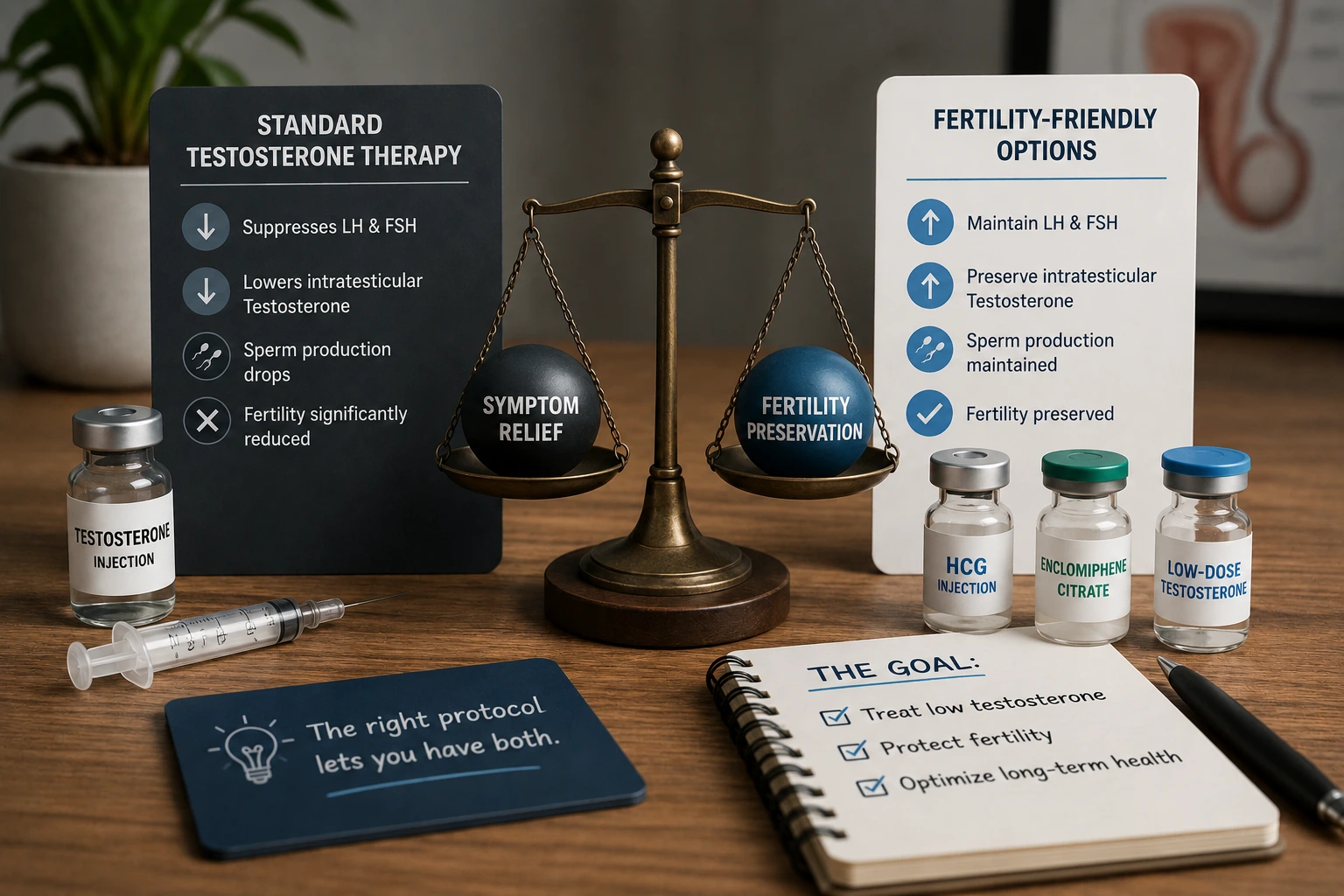
“What about fertility?” Testosterone therapy can affect sperm production. If you’re planning to have children, this needs to be part of the conversation before starting any protocol. There are ways to support both testosterone levels and fertility simultaneously.
When to Take Action
The best time to address declining testosterone isn’t when you feel terrible. It’s when you first notice things starting to shift.
If you’re a man over 40 and you’re dealing with persistent fatigue, stubborn weight gain, fading motivation, or changes in how you feel physically and mentally, those symptoms deserve attention. Not a dismissal. Not a prescription for an antidepressant. Actual investigation into what’s happening hormonally.
You’ve spent decades building your career, your family, and your life. Your body deserves the same level of attention and investment.
Take the First Step
You don’t have to accept “normal” as good enough. And you don’t have to figure this out alone.
A thorough evaluation can show you exactly where your hormones stand and what it would take to get you performing at your best. Schedule a consultation to find out what testosterone optimization could look like for you.