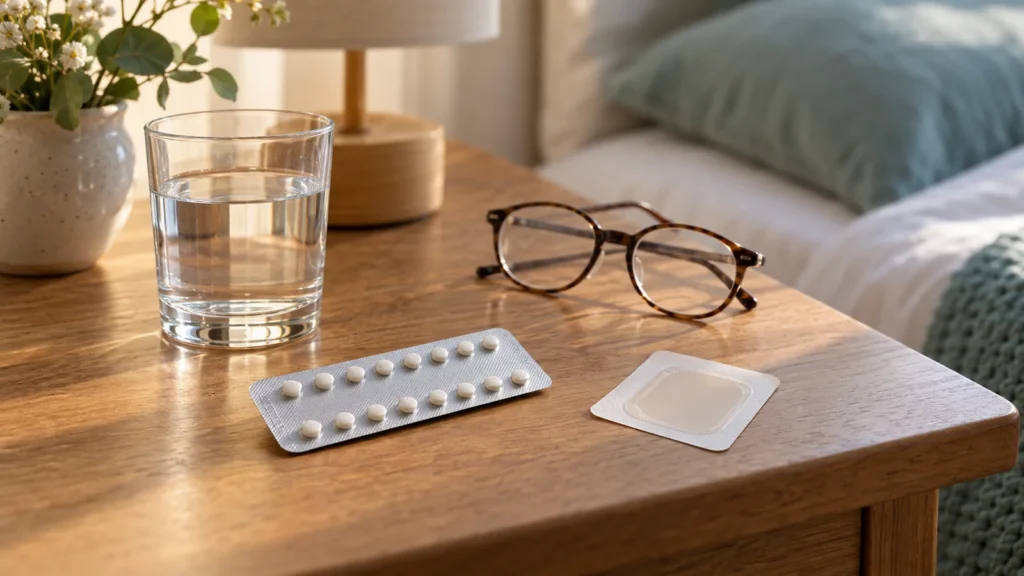
Birth Control vs HRT in Perimenopause: How They Differ
Birth control pills prevent pregnancy and hormone therapy treats menopause symptoms. See how the two differ and when women move from one to the
Read the article

Hormone Optimization Therapy · 5 min read
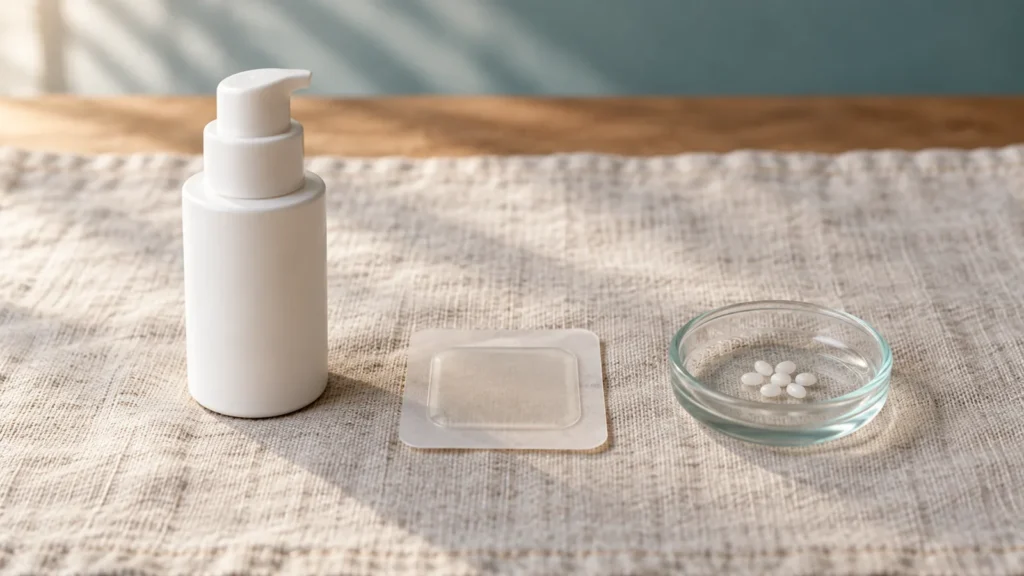
Hormone pellets vs creams, patches and pills: all four are ways to take a hormone. They differ in where the dose enters your body, how often you take it and how fast it can be changed or stopped.
The FDA record differs by form as well. The agency has approved hormone patches, gels and pills for menopause, and it says compounded hormones are not FDA approved.
A pellet is a small, solid dose of hormone that a doctor places under the skin. One testosterone pellet is FDA approved for men with low testosterone caused by certain medical conditions, and its label describes how a pellet works.
Each pellet is about 3 millimeters wide and 9 millimeters long. Once in place, the pellets “slowly release the hormone,” the label says, and it lists a new dose every 3 to 6 months.
The same label calls pellets “much less flexible for dosage adjustment” than a dose taken by mouth or a shot. To stop the hormone early, “the pellets would have to be removed,” it says.
You rub a cream or gel into your skin. One FDA approved estradiol gel goes on the upper thigh once a day, and the hormone “is absorbed through the skin into the bloodstream,” its label says. Estradiol is an estrogen hormone.
That gel comes in five dose sizes, so a doctor changes the dose by prescribing a different packet. With a daily dose, a change starts the next day.
The label also warns that the hormone can transfer to another person by skin contact, so let the gel dry first.
A patch sticks to the skin of your lower belly or buttock and releases estradiol all day and night. You change one FDA approved patch once a week and another twice a week, their labels say.
The weekly patch comes in six strengths, and its label tells doctors to adjust the dose based on how the patient responds.
To stop, you take the patch off. One label reports that hormone levels in the blood “returned to baseline levels within 24 hours” after removal.
You swallow a pill. One FDA approved estradiol tablet comes in three strengths, and a progesterone capsule label calls for “a single daily dose” at bedtime.
A swallowed hormone passes through the liver before it reaches the rest of your body. A dose given through the skin skips that first pass, one patch label explains.
A doctor changes a pill dose by prescribing a different strength, and the change starts with the next pill.
The FDA recommends that women use hormone therapies that are FDA approved. Those products “are evaluated for safety and effectiveness,” the agency says.
In October 2026, the FDA’s database of approved drugs showed this for each form.
Under the heading “MALES,” the testosterone pellet label names “replacement therapy in conditions associated with a deficiency or absence” of the body’s own testosterone. Testosterone products are approved “only for use in men,” the FDA says.
A compounded drug is one that a compounding pharmacist prepares from a prescription, The Menopause Society explains. A pellet or a skin cream made that way for a woman is a compounded drug.
“Compounded drugs are not FDA-approved,” the FDA says. That means the agency “does not verify the safety, effectiveness or quality of compounded drugs before they are marketed,” in its own words.
On whether compounded bioidentical hormones are “safer or more effective than FDA-approved hormone therapy,” the agency says it “does not have evidence” that they are.
Treatment “should be decided with your health care provider,” the FDA says. The Menopause Society lists what goes into the choice: age, health, how bad the symptoms are, preferences, the options available and cost.
Blood clot risk increases when hormones are taken by mouth and “may be lower” with a patch, gel or spray, The Menopause Society says. Its 2022 position statement adds that trials directly comparing the routes are lacking.
Hormone therapy “is not for everyone,” the FDA says. For some women it may raise the chance of blood clots, heart attacks, strokes, breast cancer or gallbladder disease.
Ask these questions about any form you are offered.
We offer more than one form. Our bioidentical hormone page lists creams and gels, pellets, oral progesterone and injections.
No form is assigned by default. You work with Dr. Adrienne Towsen, MD directly, and the choice comes from your lab results, symptoms and health history.
Lab work is part of care, and Dr. Towsen personally reviews your results. A results visit follows the labs.
The first visit is 60 to 90 minutes and costs $295. Our page on how the first visit works lists the steps. The clinic is at 795 East Marshall Street in West Chester, PA.
Talk to your doctor before you change or stop a hormone. “Do not stop or change your medication without talking with your healthcare provider,” the FDA tells patients.
Call your doctor soon for any of these.
To go over the forms with a doctor who reads your labs first, start with our page on bioidentical hormone therapy in West Chester, PA. It explains how Dr. Towsen builds a plan from your labs, symptoms and history.
Call (484) 803-5448 to book a first visit.
Birth control pills prevent pregnancy and hormone therapy treats menopause symptoms. See how the two differ and when women move from one to the
Read the article
What a thyroid antibodies test checks, what a positive result means for Hashimoto's disease, and what happens next.
Read the article
What a men's health doctor checks, which screenings come at which age, the symptoms worth a visit, and how to get ready for one.
Read the articleBook a visit at our West Chester office and bring your questions.
Book a consultation